
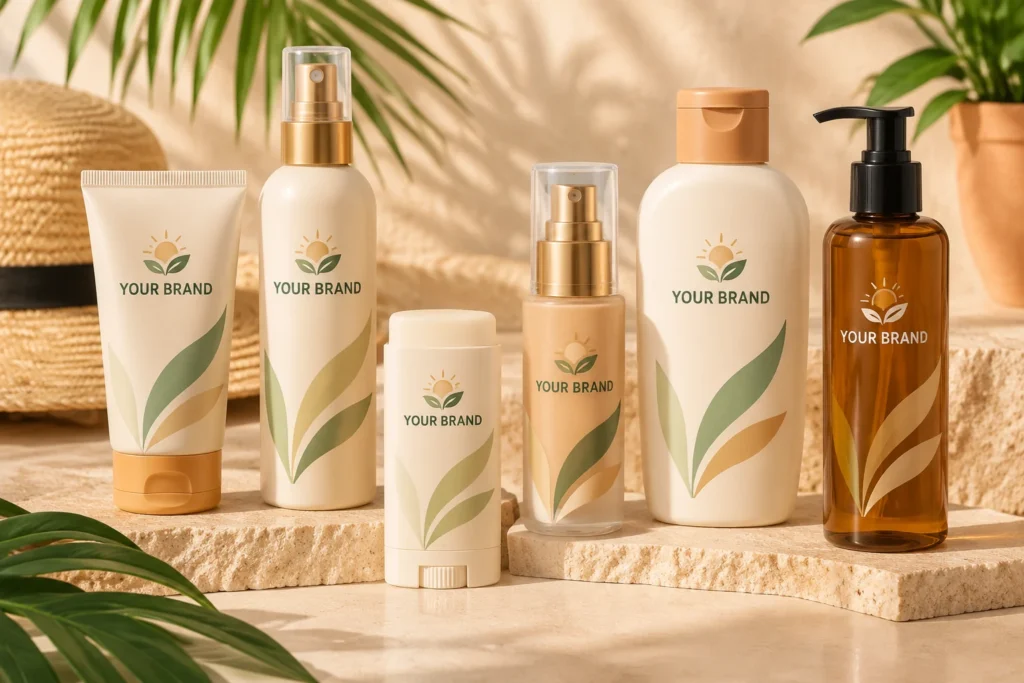
Private label sunscreen is a technically demanding project because the same product can be classified differently across markets. SPF, UVA protection, water resistance, filter status and labeling must be defined before a formula is approved or a claim is printed.
The correct starting point is the destination market and proposed claim, not a reference bottle or a target SPF alone. A sunscreen manufacturer should explain which test method, label route and documentation apply to the chosen market.
Classify the product before formulating
In the United States, sunscreen products are generally regulated as over-the-counter drugs, while the European Union treats sunscreen as a cosmetic with specific efficacy and labeling requirements. Other markets have their own positive lists, registration paths and test methods.
A product described as a cosmetic moisturizer with SPF may still be regulated as a drug in some markets depending on its claims and ingredients. Confirm the classification with the importer or regulatory adviser before committing to a label.
Choose filters and the vehicle together
UV filters differ in permitted status, maximum concentration, spectrum coverage, solubility, photostability and sensory impact. The vehicle also affects film formation, water resistance and how the product feels on skin.
A sunscreen lotion, cream, gel, stick, spray and tinted product each create different compatibility and testing questions. Spray products may need additional attention to inhalation and flammability depending on the market. Do not transfer a formula between formats without review.
SPF is a test result, not a design label
SPF is determined using the method required by the destination market and product type. The labeled value should follow the tested result and the applicable rounding or labeling rules. A laboratory simulation or ingredient estimate is not a substitute for the required testing.
Broad-spectrum or UVA protection is also assessed through a defined method. Ask how in-vitro and in-vivo testing will be handled, which laboratory will perform it and how the results will be linked to the production formula.
Plan water resistance and use conditions
If the product claims water resistance or very water resistance, the claim should be supported by the appropriate test protocol for the market. The test should reflect the labeled application and use conditions.
Even without a water-resistance claim, the product should be assessed for real use: sweat, rubbing, layering and compatibility with makeup or skincare. These observations do not replace regulatory testing, but they help interpret consumer experience.
Build the evidence file
The technical file should connect the approved formula, filter concentrations, batch records, test samples, SPF and UVA results, stability and compatibility reports, labeling and any market-specific registration or notification. Raw-material safety data should be product-specific enough for the review.
A COA, MSDS or GMP certificate is not the same as an SPF report. Keep each document tied to its purpose and version. If the formula, pack or manufacturing site changes, assess whether testing must be repeated.
Label claims need conservative language
Claims must match the evidence and local rules. Avoid saying a product is “reef safe,” “chemical free,” “waterproof” or “blocks all UV” unless the claim is substantiated and permitted. Avoid implying medical protection or guaranteed prevention.
Directions for use, warnings, net content, ingredient declaration, batch information and the responsible business details should be reviewed on the final artwork. The label review should happen before print, not after bulk packing.
Packaging considerations for sun care
Sunscreens can be susceptible to heat, light, oxygen, evaporation and product separation. The pack should protect the formula and dispense the intended dose. Tubes, pumps, airless systems, sticks and sprays each require different compatibility and filling checks.
Confirm the pack is tested with the final formula and that decoration does not interfere with the label information or the dispensing mechanism. A travel-size claim should match the actual fill and applicable transport rules.
Private label versus custom ODM sunscreen
Both routes can use an agreed formula platform or a development project, but the commercial and technical scope must be explicit. Ask who owns the formula, what testing is already available, whether the exact formula is exclusive and what changes are allowed before the test is repeated.
At Sandio, sunscreen projects are reviewed from 1,000 pcs per SKU, subject to formula, pack and market feasibility. A sunscreen claim cannot be confirmed from a product mockup or a generic formula sheet.
Sun care approval checklist
- Destination market and product classification documented.
- Filter list and concentrations reviewed against local rules.
- SPF and UVA test method agreed.
- Water-resistance claim supported if used.
- Stability and pack compatibility tested.
- Directions, warnings and claims approved.
- Test reports match the production formula and site.
Set the claim and test plan before the formula
Write the proposed SPF, broad-spectrum, water-resistance and sensory claims in a single project document. For each claim, record the intended market, test method, responsible party and acceptance criterion. If a claim cannot be supported, remove it before the artwork is designed.
Confirm whether the test sample will be the final formula in the final pack and whether the manufacturing site matters to the report. A change in filter source, fragrance, fill or component can require a new review. Ask the laboratory and factory to agree on sample custody and version identification.
What a buyer should receive before bulk
The buyer should receive a product specification, filter and ingredient information, stability and compatibility plan, test reports applicable to the market, final label review and a clear statement of what remains the importer’s responsibility. A screenshot of an SPF result is not a complete product file.
Before release, compare the production batch with the approved sample and confirm that the tested formula matches the manufactured formula. If a substitution is proposed, pause and assess the claim and testing impact. Sun care is not a category for informal changes.
Pack and use experience
Test the actual pack for leakage, dispensing, separation, label durability and transport. A sunscreen that is difficult to dispense or leaks in a travel bag will create complaints even if the laboratory result is acceptable. Provide clear directions and warnings that match the formula and market.
Define the purchasing decision in stages
Use two approval gates. The first gate confirms the filter system, target SPF, UVA approach, use directions and proposed pack. The second gate confirms test results, final formula, pack compatibility and label. Do not print mass packaging before the second gate. If a filter or component changes after testing, ask whether the report remains representative.
Keep the target market on the purchase order. A sunscreen that is acceptable for one jurisdiction may need a different formula, test or label elsewhere. The brand should identify the importer or responsible party who will review the market file and keep the final decision with qualified regulatory support.
Prepare the sunscreen product file as one package
Keep the formula, pack specification, filter information, test samples, SPF and UVA results, stability data, labeling and market review in one indexed file. Each document should identify the version it supports. When a buyer or importer asks a question, the answer should be traceable to the approved product rather than a generic marketing sheet.
If a test is still pending, state that clearly in the approval record. Do not release final packaging with the intended SPF claim until the required evidence is accepted. A conservative launch date is better than an expensive label correction.
Frequently asked questions
Can I make a 50 SPF sunscreen without testing?
No. The labeled SPF should be supported by the required test method for the destination and product. Ingredient estimates and competitor labels are not evidence.
Is sunscreen a cosmetic in every country?
No. Classification differs. The United States generally regulates sunscreen as an OTC drug, while the EU treats it as a cosmetic with specific efficacy rules. Confirm the destination before finalizing the formula and label.
Can the same sunscreen formula be sold in the US and EU?
It may be possible, but filters, concentrations, testing, claims and labeling must be reviewed for each market. A formula that fits one jurisdiction cannot be assumed to fit another.
What testing should I request?
At minimum, discuss SPF, UVA or broad-spectrum testing, water resistance if claimed, stability, pack compatibility and the market-specific safety and labeling requirements. The exact program depends on the product and destination.
What is the MOQ for sunscreen at Sandio?
OEM and ODM projects start at 1,000 pcs per SKU. Final feasibility depends on formula, pack and market-specific testing and documentation.
Official references
- U.S. FDA — Sunscreen products
- EU — Regulation (EC) No 1223/2009 on cosmetic products
- U.S. FDA — Cosmetics laws and regulations
Turn the guide into a production brief.
Review the commercial scope, then confirm formula, packaging, market and quantity with the team.
Plan a focused OEM or ODM launch.
Sandio Cosmetics reviews the formula direction, packaging, destination market and order quantity before quotation. OEM and ODM projects start at 1,000 pcs per SKU.