
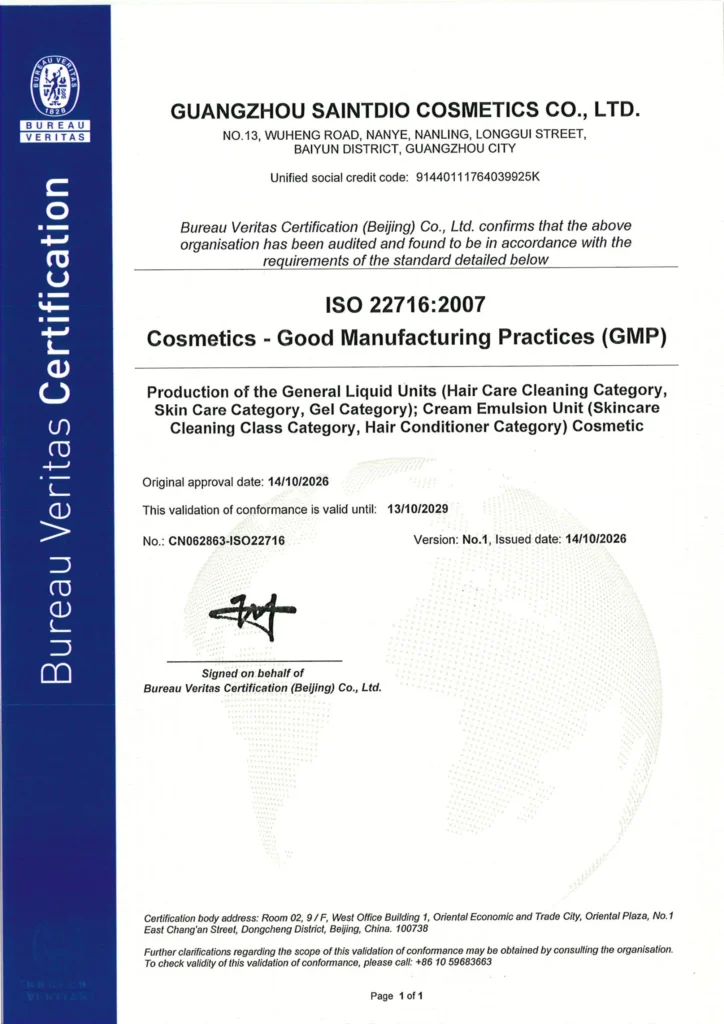
ISO 22716 is an international guideline for the good manufacturing practices of cosmetic products. It addresses production, control, storage and shipment, with the goal of supporting product quality and consumer safety. A certificate can be useful evidence during supplier selection, but it must be checked for scope, site and validity.
GMP is a system of controls, not a guarantee that a finished product is compliant in every market. Buyers should review the certificate and the underlying quality practices together with product-specific specifications, testing and labeling.
What ISO 22716 covers
The standard provides guidance on the production, control, storage and shipment of cosmetic products. It covers personnel, premises, equipment, raw materials and packaging, production, quality control, documentation, complaints, recalls and change control. The practical question is how those controls are applied to your product and site.
ISO 22716 is not a recipe for a formula and does not approve an ingredient or a marketing claim. It describes a quality-management framework. The product still needs a specific safety, compatibility, stability and labeling review.
Certificate or compliance statement
A certification body may issue a certificate after an audit. Ask for the certificate holder, site address, standard and edition, scope, issue and expiry dates, certificate number and issuing organization. A logo or a one-line statement is not enough.
Check whether the certificate covers the operations used for your product. A site certificate may not cover a different facility, a subcontracted process or an unrelated product category. If the manufacturer cannot explain the scope, ask for clarification before treating the document as evidence.
Look beyond the certificate
Ask to see the quality manual summary, batch-record structure, deviations and corrective-action examples, supplier approval, training, calibration, cleaning and pest-control records. The review should show that the system operates between audits.
A reputable factory should be able to explain what changed after the last audit and how complaints are investigated. Do not expect a perfect record with no issues; look for a controlled process for finding and correcting issues.
Verify personnel and training
Ask who is responsible for quality, who can approve specifications and deviations, and how production staff are trained for the specific line and pack. Temporary or seasonal workers should receive the same controls.
The site should have clear responsibilities for incoming materials, compounding, filling, packing, release and records. If quality is described only as a final inspection step, the system may be too narrow.
Review premises and equipment controls
Look for a defined flow of people, materials and waste, appropriate clean areas, equipment cleaning and calibration, and control of utensils and containers. Ask how water, compressed air or other process utilities are monitored where relevant.
The 300,000-class clean workshop and 5,890 m² facility are useful facts about Sandio, but they do not replace a project-specific review. The buyer should connect the claimed capability to the actual manufacturing step and product risk.
Check raw-material and packaging controls
Ask how incoming materials are approved, sampled, labeled and stored. Confirm that rejected material is segregated and that supplier changes are controlled. For packaging, review compatibility, cleanliness, filling and closure checks.
Request the specification and safety information appropriate to the formula. A generic COA for a commodity ingredient is not a finished-product COA, and an MSDS is not a market authorization.
Connect GMP to product-specific testing
Quality control should include the finished product tests relevant to the formula and market. Stability, compatibility, microbiology, pH, viscosity, appearance, odor, fill and package function may need to be tested. The exact program should be based on risk and destination.
Ask who reviews the results and how an out-of-specification result is handled. The product should not be released on the assumption that a GMP certificate makes testing optional.
Understand FDA wording
FDA does not approve cosmetic products or issue cosmetic GMP certificates. A document described as an FDA certificate should be examined carefully. It may be a third-party validation of conformance with a guidance document, which is different from FDA product approval.
Sandio’s information presents its Bureau Veritas document as validation of conformance with the U.S. FDA Cosmetic GMP Guidelines (2022), not as FDA approval. Buyers should keep the wording precise in their own supplier records.
Use a GMP supplier audit checklist
| Area | Evidence to request | Decision point |
|---|---|---|
| Legal site | Licence and certificate with address | Does the scope match the manufacturer? |
| Quality system | Manual summary, audit and CAPA process | Is there controlled change and improvement? |
| Production | Batch record and in-process checks | Can the lot be traced through each step? |
| Materials | Approved supplier and incoming checks | Are material changes controlled? |
| Packaging | Component specification and compatibility | Does the pack suit the formula? |
| Testing | Product-specific methods and reports | Is the release decision documented? |
| Complaints | Intake, investigation and recall process | Can an issue be traced and acted on? |
Questions for a factory visit or remote audit
- Who approves a new formula and a specification change?
- How are raw materials and components released?
- What records follow a batch through compounding, filling and packing?
- How are deviations investigated and closed?
- Which product tests are routine and which are project-specific?
- What happens after a complaint or recall?
- How is the certificate scope maintained between audits?
How to document a GMP review
Keep a supplier file containing the legal entity, site address, manufacturing licence, GMP certificate, audit date, certificate scope, key quality contacts and the next review date. Add a note explaining any difference between the sales entity and the manufacturing site. This file should be easy to update when a certificate or site changes.
During a remote audit, ask for a process walk-through from receiving to release. Request records for one representative batch with confidential commercial information removed. Check how the batch was weighed, mixed, filled, checked and released, and whether the record shows who approved each step.
A certificate can open the conversation, but the review should establish that the controls are real. Ask how deviations, complaints, supplier changes, calibration and training are managed. Those answers show whether the quality system can protect a repeat order.
Use precise language in marketing
Describe ISO 22716 as a GMP certification where the certificate supports that wording. Describe the U.S. FDA document as a validation of conformance, not FDA approval. Precision protects the brand’s credibility and prevents a buyer from discovering an overstated claim during due diligence.
What to do when a certificate expires
Set a reminder well before the expiry date and request the renewed certificate or surveillance evidence. Do not assume renewal is automatic. Confirm the site, scope and standard remain the same. If the supplier changes location or subcontracts a process, update the supplier file even when the existing certificate still looks valid.
If a buyer is comparing two factories, a current certificate with a clear scope is more useful than a long list of logos. Ask for the audit report summary and the corrective actions closed after the most recent audit. The quality system should show how issues are found, corrected and prevented from recurring.
Keep the certificate claim proportional
Use the certificate to explain the manufacturing quality system, not to imply that every product is automatically compliant in every market. A buyer should still see the product specification, testing plan and destination review. This proportional language is more credible in a supplier audit because it shows that the manufacturer understands the boundary between a site system and a finished product.
Frequently asked questions
Is ISO 22716 mandatory in every market?
It is an international GMP guideline and can be used in supplier qualification. Market requirements differ, so confirm the applicable legal and customer requirements for the destination rather than treating one certificate as universal authorization.
Does ISO 22716 certify a product?
No. It relates to the manufacturing quality system. The finished formula, pack, claims and market documentation still need product-specific review.
How can I verify a GMP certificate?
Check the holder, site, scope, standard edition, certificate number, issuer, issue date, expiry and surveillance status. Ask the certificate body or use its verification service where available.
Does a Bureau Veritas validation mean FDA approval?
No. A third-party validation of conformance is not FDA approval. Read the document and its scope carefully, and describe it accurately in marketing and buyer files.
Can a supplier show a certificate without a site audit?
A certificate normally follows an audit by the issuing body, but buyers should still verify its scope and current status. For a significant project, request a site or remote audit and review product records.
Official references
- ISO 22716:2007 — Cosmetics Good Manufacturing Practices
- U.S. FDA — Cosmetic Good Manufacturing Practices
- EU — Regulation (EC) No 1223/2009 on cosmetic products
Turn the guide into a production brief.
Review the commercial scope, then confirm formula, packaging, market and quantity with the team.
Plan a focused OEM or ODM launch.
Sandio Cosmetics reviews the formula direction, packaging, destination market and order quantity before quotation. OEM and ODM projects start at 1,000 pcs per SKU.