
MoCRA compliance is a shared project between the brand, importer, responsible persons and manufacturing partners. The Modernization of Cosmetics Regulation Act of 2022 expanded FDA’s authority over cosmetics in the United States, including requirements related to safety substantiation, facility registration, product listing, adverse-event records and GMP.
A factory certificate or supplier document is not, by itself, proof that a finished branded product complies. The brand and its US commercial partners should assign each obligation, verify current FDA guidance and keep product-specific records rather than relying on a generic document pack.
Start with the product and the commercial role
Confirm whether the product is regulated as a cosmetic, a drug, or both. Moisturizers and cleansers may be cosmetics, while products making drug claims or products regulated as sunscreen drugs require a different analysis. The answer affects labeling, testing and facility obligations.
Write down who is the brand owner, importer, distributor, contract manufacturer and any responsible person for the U.S. market. A Chinese factory can manufacture and provide records, but it cannot decide the brand’s legal role for it.
Use current FDA guidance because implementation dates and processes can change. This article is an operational checklist, not legal advice.
Map MoCRA responsibilities before sampling
| Workstream | Practical owner | Evidence to keep |
|---|---|---|
| Safety substantiation | Brand or responsible party with qualified expertise | Product-specific safety file and rationale |
| Facility registration | Facility operator, with brand confirmation | Registration record and renewal calendar |
| Product listing | Responsible person or brand | Listing record, updates and product identity |
| Adverse-event reporting | Brand or designated contact | Procedure, contact route and records |
| Label review | Brand with regulatory review | Approved artwork and market-specific claim file |
| GMP | Manufacturer and brand supplier approval | Audit evidence, batch records and corrective actions |
Do not assume that one party’s registration covers every product or every facility. Map the actual product and site relationships.
Prepare product-specific safety substantiation
Safety substantiation should be based on the formula, ingredients, concentrations, intended use, target population and available evidence. A generic statement that “all ingredients are approved” is not enough to show how the finished product is safe under its intended conditions.
Ask the manufacturer for the exact formula representation, raw-material specifications, safety data sheets, impurity or allergen information where relevant, and manufacturing controls affecting the finished product. The brand’s qualified safety reviewer should determine what evidence is adequate.
Keep the safety file tied to the approved formula and pack. If the formula, use or labeling changes, review whether the original assessment remains valid.
Connect registration and listing to the actual product
Facility registration and product listing are operational records, not marketing badges. The brand should know which facility is associated with the product, who maintains the listing, how product identity is described and when updates are needed.
Ask the factory to provide the legal site name, address, contact and relevant manufacturing scope. Confirm that the facility named in the record is the facility that actually compounds or processes the product.
If multiple sites or subcontractors are involved, document each role. A brand should not discover a new facility or process change only after the listing and labels are complete.
Build an adverse-event and complaint workflow
Consumer complaints can arrive through the brand’s website, marketplace, distributor or social channels. Define a single intake route, assessment process, escalation owner and retention location. Product identity, lot or batch information should be captured in a way that allows investigation.
Do not publish a customer-service email and assume the obligation is covered. Train the team to recognize serious adverse events and route them promptly for evaluation. Keep the process and records under review.
Your manufacturing partner should be able to respond to lot-specific quality questions with batch and distribution information where applicable.
Confirm GMP evidence rather than a slogan
U.S. FDA’s cosmetic GMP requirements sit alongside the international ISO 22716 framework, but they are not the same document. A supplier claiming “FDA approved” should be asked what the statement actually means. FDA does not approve cosmetic products or issue cosmetic GMP certificates.
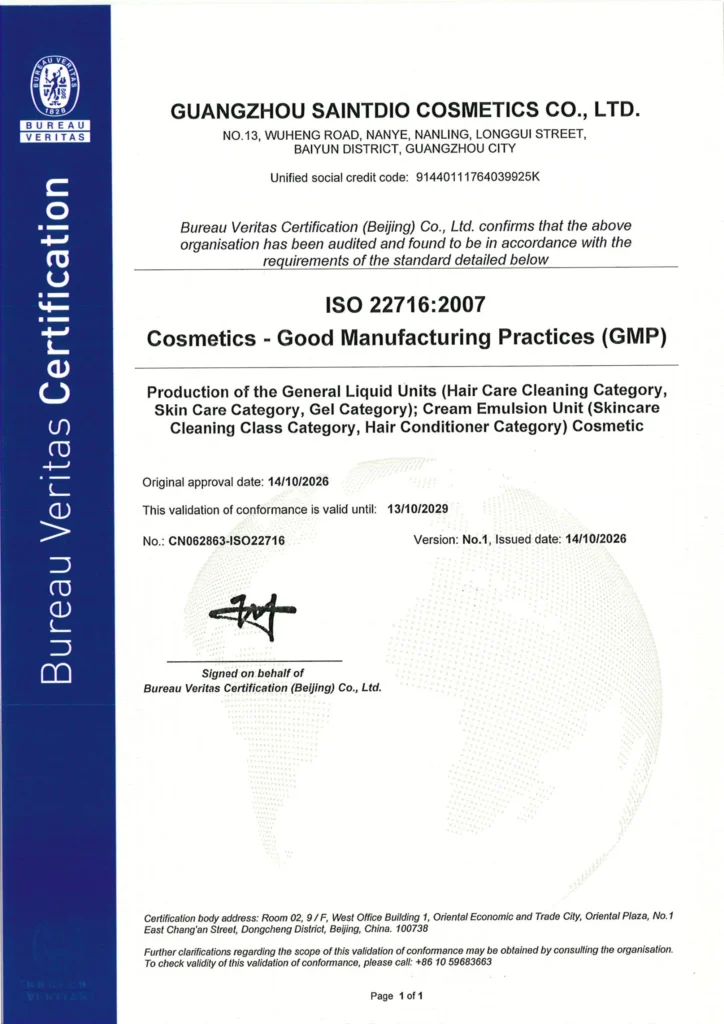
Ask for the audit scope, issuing organization, site name, certificate number, validity dates and corrective-action process. Verify that the document covers the relevant manufacturing operation. A certificate on a sales page is not a substitute for a site audit or product-specific quality records.
Sandio’s quality and compliance page lists our ISO 22716 certificate and a Bureau Veritas validation of conformance with the U.S. FDA Cosmetic GMP Guidelines. The company describes the FDA document accurately as a validation of conformance, not as FDA approval or product certification.
Review labels and claims before final artwork
Labeling and claims need a product-specific review. Fragrance allergen disclosure, warning statements, ingredient names, net quantity, business contact information and any drug claim can change the risk profile. Different channels may impose additional requirements.
Do not copy a competitor’s label. Market-specific rules, formula differences and product classification can make the same wording unacceptable. Use a regulatory reviewer and keep the approved label version with the product file.
If the product is also a drug, cosmetic-drug labeling and facility requirements can differ. Confirm the classification before ordering packaging.
Create a launch record checklist
- Product classification and intended use documented.
- Brand, importer and responsible roles assigned.
- Formula-specific safety file prepared and reviewed.
- Facility registration and product listing records maintained.
- Adverse-event and complaint procedure in place.
- GMP and site evidence verified against the actual manufacturer.
- Final label, claims and product record approved.
The record should be reviewed whenever the formula, supplier, pack, label or market changes.
Make the brand and factory roles visible
Create a responsibility matrix with columns for the brand, importer, manufacturer, testing laboratory and regulatory adviser. For each requirement, write who supplies the data, who reviews it, who submits a record and who keeps the final evidence. This prevents a document from being lost between parties who each assume someone else owns it.
When a factory says it “supports compliance,” ask for examples of what that means in practice. It may mean providing specifications, batch records, test support or labeling input. It does not automatically mean taking over the brand’s product listing, safety substantiation or adverse-event obligations.
Keep the supplier approval file separate from the product file. The supplier file explains why the factory is qualified; the product file explains why the specific formula, pack and label are appropriate. Both may be needed in a dispute or audit.
Review the launch file as a living system
Set a review date before the first shipment and again after any change. A new fragrance, pack, claim, facility or market can affect the evidence. The brand should know who can approve a change and which records must be updated.
If a distributor asks for a document that is not already in the file, do not ask the factory to issue a generic replacement. Clarify the required document, product identity, market and purpose, then provide accurate evidence or explain the limitation.
Keep a market-entry calendar
Put compliance tasks into the launch calendar with owners and dependencies. Formula review, safety-file preparation, label approval, facility evidence and listing records should not be treated as a single administrative task at the end. If a product record depends on a supplier file, request it before the purchase order so missing information cannot delay release.
When the launch involves a distributor, ask who will handle customer complaints and who can contact the brand. The records should connect the marketplace, brand, distributor and manufacturer without exposing confidential formulas to parties who do not need them.
Frequently asked questions
Does MoCRA apply to a Chinese manufacturer selling to a US brand?
The U.S. requirements attach to products and responsible commercial roles in the U.S. market as well as manufacturing responsibilities. The brand and importer should map each obligation and confirm current FDA guidance rather than assuming the factory alone covers compliance.
Does an FDA GMP certificate prove a product is compliant?
No. FDA does not approve cosmetics or issue cosmetic GMP certificates. A third-party validation or audit can support supplier selection, but the brand still needs product-specific safety, labeling and record review.
Who owns product listing?
The responsible commercial party and regulatory adviser should confirm this for the project. The manufacturer can provide facility and product information, but the brand should not leave the listing obligation undefined.
Are all cosmetic labels the same under MoCRA?
No. Classification, ingredients, fragrance allergens, warnings, claims and channel requirements can affect labeling. Review the final artwork against the destination and product type.
How often should the compliance file be updated?
At minimum when the formula, facility, packaging, claims or market changes. Also review current FDA guidance and internal ownership on a scheduled basis.
Official references
- U.S. FDA — Modernization of Cosmetics Regulation Act of 2022 (MoCRA)
- U.S. FDA — Cosmetic Good Manufacturing Practices
- U.S. FDA — Cosmetics laws and regulations
Turn the guide into a production brief.
Review the commercial scope, then confirm formula, packaging, market and quantity with the team.
Plan a focused OEM or ODM launch.
Sandio Cosmetics reviews the formula direction, packaging, destination market and order quantity before quotation. OEM and ODM projects start at 1,000 pcs per SKU.