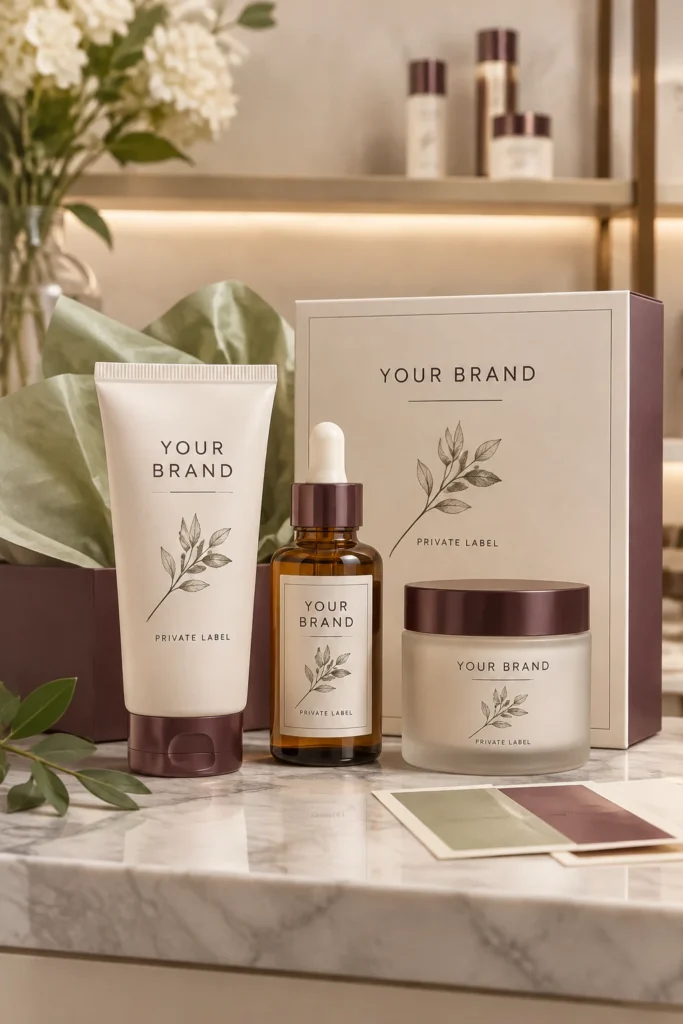
Private label skincare is a model in which a brand sells a product manufactured under its own name. It is not automatically a ready-made product pulled from a shelf. The practical result depends on the formula source, packaging scope, exclusivity, testing and market requirements agreed between the brand and manufacturer.
For a buyer comparing quotations, the useful questions are who owns the formula, what can be changed, what the minimum order is and which responsibilities remain with the brand. Cost and customization should be compared at that level, not by looking only at a headline unit price.
What “private label” means in a real project
The term private label describes the commercial relationship: the product carries the buyer’s brand. Manufacturing may use an agreed base formula, a customer-supplied formula or a newly developed ODM formula. Those routes carry different development work, ownership terms and timelines.
At Sandio Cosmetics, private label is part of the OEM/ODM custom-production offer. Projects begin at 1,000 pcs per SKU and are reviewed against the formula, packaging, destination market and intended claims. There is no separate ready-made stock catalogue presented as private label.
Ask every supplier to state the formula origin in writing. “Private label” alone does not tell you whether the formula is exclusive, how many changes are included or whether another buyer can use the same formulation.
The four parts of a private label scope
| Scope | Typical decision | Why it matters |
|---|---|---|
| Formula | Agreed base, customer formula or ODM development | Determines development cost, rights and approval |
| Primary pack | Stock component, custom color or new mould | Controls MOQ, lead time and compatibility testing |
| Decoration | Label, screen print, hot foil, sleeve or carton | Drives artwork, proofing and minimum run |
| Market support | Testing, documents and claim review | Defines what the brand can responsibly place on the market |
A quotation is incomplete until all four parts are described. A cheap formula with an imported custom component is not necessarily a cheaper project; a standard component can still require a new label, carton and testing plan.
What drives private label skincare cost
The largest cost drivers are formula complexity, fill size, component cost, decoration, order quantity, testing and market documentation. The cost of a cream is not determined by its category name. Two moisturizers with the same fill can have very different ingredient, processing, stability and packaging requirements.
Packaging often changes the economics more than buyers expect. A pump, airless bottle, jar, tube and dropper have different component prices, filling speeds, loss rates and decoration minimums. A custom-colored component may require a higher component order than the finished-product MOQ.
Testing and regulatory preparation should also be budgeted. The exact work depends on the destination: safety assessment, stability, microbiology, compatibility, SPF testing or other claim support may apply. Ask which items are included in the quotation, which are quoted separately and which remain the importer’s responsibility.
Where customization is technically limited
Customization is limited first by formula compatibility. A desired texture, active level, fragrance, color or pH may not remain stable in every package or with every ingredient combination. The factory should explain the trade-off rather than simply accepting a list of requests.
Second, packaging availability is constrained by tooling, component minimums, lead time and decoration method. A reference image may show a custom mould that is not available at the planned volume. A technically suitable stock component with a distinctive label and carton can be a better first launch than an unavailable bottle.
Third, claims and labeling are governed by the destination market. No manufacturer can guarantee that an ingredient name, testimonial, before-and-after image or phrase is acceptable everywhere. The brand and its regulatory adviser must approve final claims against the market rules.
Private label versus OEM and ODM
| Model | Formula source | Best fit | Buyer question |
|---|---|---|---|
| Private label | Commercial model; formula source must be defined | Brand wants product under its own identity | Is the formula agreed, exclusive or shared? |
| OEM | Customer-owned or jointly agreed formula | Buyer has a formula or defined direction | Who confirms technical feasibility and ownership? |
| ODM | Manufacturer develops around a brief | Buyer needs formulation support | What development and exclusivity are included? |
The labels overlap in everyday sales conversations. That is why a written scope matters more than the name on the quotation. Clarify development, ownership, sample revisions and permitted reuse before paying a deposit.
How to compare private label quotations
Put every quote into the same comparison table. Include formula scope, fill, primary component, decoration, artwork responsibilities, samples, testing, documentation, packing, Incoterm, lead time and payment terms. Note what is excluded.
Ask whether the price is for the first run only and what changes at a higher or lower quantity. Confirm whether the component price is fixed, subject to availability or tied to a separate component order. Ask when the quote expires.
Request a sample that represents the intended production formula and pack, not an unrelated display item. Record the sample version and the approval criteria. A clear approval trail is more valuable than a large catalogue of unverified images.
A realistic 1,000-piece launch plan
Begin with one formula and one pack. Define the market and channel, write the brief, request a feasibility response, compare the cost basis and schedule a sample review. Only after the product and pack are technically aligned should the brand invest in final artwork and launch assets.
Keep a reserve for a second sample round, label correction, testing follow-up or a component substitution. The need for another round is not automatically a failure; it is a normal part of resolving a technical question before scale.
At bulk approval, lock the formula specification, fill, component, decoration, label, carton and retained reference. Use that approved record for incoming inspection and future repeat orders.
Questions to ask before signing
- Which exact formula is being quoted, and who owns it?
- What changes are included before the formula is locked?
- What is the MOQ for the formula, component and decoration separately?
- Which tests and documents are included for my destination?
- Who approves claims, labels and product information?
- What sample and bulk approval records will be retained?
- What happens if a component is discontinued or delayed?
How to evaluate a private label sample
Evaluate the sample against the written brief before discussing aesthetics. Check the texture, application, fragrance, color, fill, pack function and label fit. Record the exact version tested and the date. If the brand has several reviewers, consolidate their comments into one list with must-fix issues separated from preferences.
Ask what the sample represents. It may be a laboratory prototype made with a different component from the proposed production pack. That distinction matters because the formula and package must be compatible before bulk. A production-representative sample may be a separate step after the formula and component are stable.
A private label project should end with a controlled reference: approved formula specification, approved pack, artwork, test plan and retained sample where available. Without that record, a repeat order becomes a new negotiation rather than a controlled production run.
What should trigger a quotation review
Review the quotation when the fill, component, decoration, formula, quantity or destination changes. Those are not cosmetic edits. A new airless pack may change compatibility, a new market may add testing, and a new fragrance may require an updated safety assessment. Ask the manufacturer which changes affect price, MOQ and timing.
Do not compare a final landed-cost quote with an ex-works placeholder. Keep the same specification and documented inclusions. The cheapest-looking offer may be missing packing, cartons, testing or the actual component.
Frequently asked questions
Is private label the same as white label?
The terms are often used loosely. Private label describes the brand arrangement; white label can imply a ready-made formula offered to multiple buyers. Ask for the formula source, exclusivity and customization terms rather than relying on the label.
What is the MOQ for private label skincare at Sandio?
OEM and ODM projects start at 1,000 pcs per SKU. Final feasibility depends on the formula, pack, decoration and destination requirements.
Can I customize the fragrance and packaging?
Fragrance, color, texture direction, component and decoration can be reviewed, but each change must be checked for compatibility, minimum order, testing and market rules.
Are testing and certification included in the unit price?
Not automatically. The quotation should state which tests, documents and regulatory tasks are included and which are separate or owned by the brand or importer.
Can the same formula be sold to another brand?
That depends on the agreed formula ownership and exclusivity terms. Put the commitment in the contract and project specification, not only in a sales conversation.
Official references
- U.S. FDA — Cosmetics laws and regulations
- EU — Regulation (EC) No 1223/2009 on cosmetic products
- ISO 22716:2007 — Cosmetics Good Manufacturing Practices
Turn the guide into a production brief.
Review the commercial scope, then confirm formula, packaging, market and quantity with the team.
Plan a focused OEM or ODM launch.
Sandio Cosmetics reviews the formula direction, packaging, destination market and order quantity before quotation. OEM and ODM projects start at 1,000 pcs per SKU.