
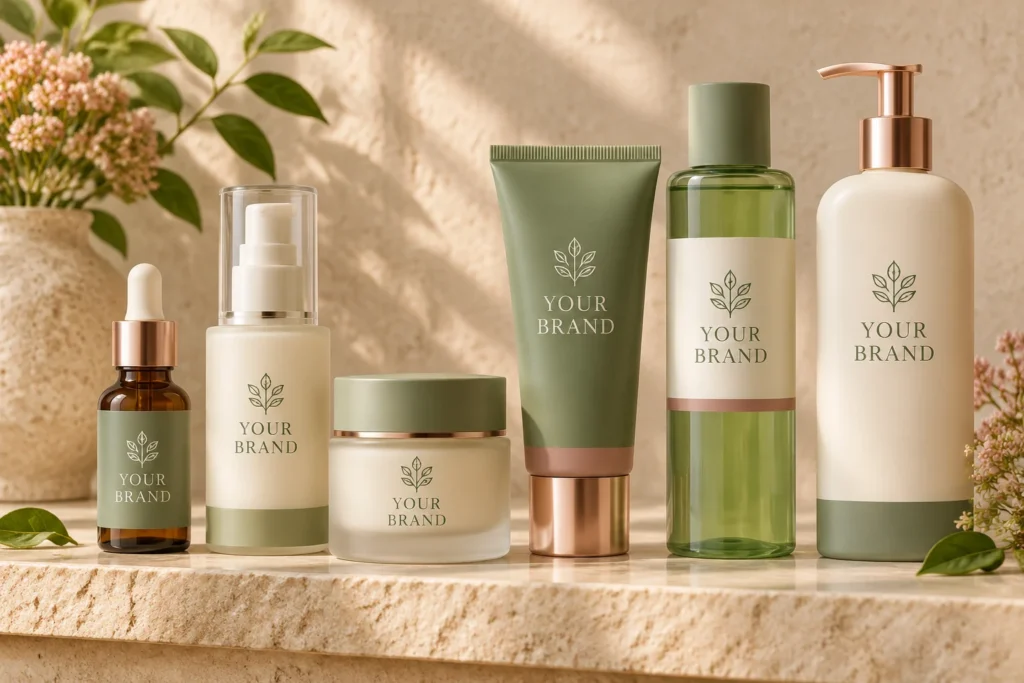
The fastest way to start a skincare line is not to order bottles first. Start with one target customer, one product problem and one sales channel; then build a formula brief, packaging direction, testing plan and market-entry budget around that decision. A focused first SKU is easier to approve, document and improve than a broad range with no clear reason to exist.
This guide is written for founders preparing an OEM or ODM project. It assumes the brand will work with a contract manufacturer and will confirm final feasibility against the destination market rather than relying on a generic product checklist.
1. Define one customer and one purchase problem
Write a one-page positioning statement before discussing formulas: who buys, where they buy, what they use now, what they want to replace and what proof they expect. “For oily skin” is not enough. A sharper brief might be “a lightweight daily moisturizer for humid climates, sold through a professional salon channel, with fragrance-free positioning and a simple refill-conscious pack.”
The statement should identify the channel because channel changes almost every downstream decision. A spa brand may value treatment-room sizes and professional language; an e-commerce brand may need compact cartons, clear directions and strong shelf impact; a distributor may need a range that is easy to explain across several skin types.
Do not invent a medical claim to make the product sound stronger. A cosmetic product can support appearance and care routines, but market-specific rules determine which claims are acceptable. Build the concept around a routine need, texture preference, format or sensory experience that can be demonstrated honestly.
2. Choose a focused product architecture
A first launch usually works better with a hero product plus one or two support products than with ten unrelated SKUs. The hero should carry the brand idea; a companion cleanser, toner or moisturizer can create a routine without multiplying development work. For a haircare or body-care extension, apply the same logic: solve one adjacent routine problem rather than jumping categories.
Build a product map with four columns: role in the routine, format, likely volume and reason the customer needs it. If a SKU cannot answer all four, remove it from the first round. This protects cash, simplifies packaging approvals and makes it easier to test a coherent message in the market.
At Sandio, OEM and ODM projects begin at 1,000 pcs per SKU. A smaller number of well-chosen SKUs is usually a better first plan than spreading that minimum across many weak ideas.
3. Choose the right manufacturing model
OEM generally means production based on a customer-owned or jointly agreed formula. ODM means the manufacturer helps develop a formula around the brand brief. Private label is a commercial model in which the brand sells a product made for it; the exact level of formula and pack customization must be agreed in the project scope.
At Sandio, private label, OEM and ODM are custom-production routes rather than ready-made stock. Production starts from an agreed formula direction and begins at 1,000 pcs per SKU. The relevant question is not which label sounds cheapest, but who supplies the formula, how much development is required and what rights the brand needs.
| Decision | What to settle | Evidence to keep |
|---|---|---|
| Formula source | Customer formula, agreed base or new development | Formula brief and signed specification |
| Exclusivity | Whether the exact formula is reserved for the brand | Written project terms |
| Packaging | Stock component or custom mould | Technically approved component list |
| Market | Destination and sales channel | Regulatory and testing requirements |
| Quantity | SKUs and units per SKU | Approved quotation and production plan |
Do not treat a verbal promise of exclusivity as a formula right. The contract, formula specification and artwork approval should make ownership and permitted use explicit.
4. Write a formula brief before requesting prices
A useful brief describes the intended skin feel, application, rinse-off or leave-on use, fragrance direction, color, pH target if relevant, ingredient exclusions, packaging contact and destination market. It should also say which sensory or performance claims must be tested and which marketing language is still undecided.
Avoid giving the factory a list of trending ingredients and asking for “the best formula.” Ingredient lists do not explain how the product should behave. It is more useful to compare a reference texture, clarify how much slip or richness is wanted, and explain whether the product will be used alone or in a routine.
Ask the manufacturer to return a short feasibility response: proposed formula platform, critical ingredients, possible claims to verify, sample route, packaging constraints and any information still missing. That response becomes the basis for a quotation rather than a generic brochure.
5. Select packaging before final artwork
Packaging is part of the formula system. A dropper, airless pump, tube, jar and spray each create different compatibility, filling, evacuation and travel questions. Choose the primary component early enough for the laboratory to test the product in the intended pack.
Ask about fill volume, headspace, closure torque, decoration method, label dimensions, carton fit and the minimum order for the chosen component. A reference bottle that looks distinctive may not be available at the project quantity or may have a long lead time. Confirm the technical and commercial availability before designers produce final dielines.
Artwork should be reviewed against the actual label shape, legal panel, barcode placement and required market text. A beautiful digital mockup is not an approved production file.
6. Build a market-entry testing plan
Testing should follow the formula, pack, use conditions and destination market. Common project discussions include stability, compatibility, microbiology, challenge testing where appropriate, safety assessment support, and claim substantiation. Sun care, color cosmetics and products making specific labeling claims may need additional work.
For the United States, the Modernization of Cosmetics Regulation Act of 2022, known as MoCRA, affects responsibilities around safety substantiation, facility registration, product listing, adverse-event records and GMP. For the European Union, Regulation (EC) No 1223/2009 requires a responsible person, a Product Information File and CPNP notification before placing a product on the market. These are different systems; do not reuse a U.S. document pack as proof of EU compliance without review.
Define who owns each task: brand, importer, responsible person, testing laboratory and factory. The manufacturer can supply product-specific information and testing support, but the brand should not assume the factory has taken over the brand’s legal role.
7. Calculate the launch budget beyond the bulk formula
The quotation headline is rarely the complete launch cost. Include formula development if applicable, samples and courier costs, packaging and decoration, label printing, testing, regulatory review, artwork preparation, production inspection, cartons, freight, duties, warehousing and a reserve for rework or additional approvals.
Compare quotations on the same basis: fill size, formula scope, packaging specification, decoration, documentation, testing responsibility, packing format, Incoterm and validity. A lower unit price with fewer included steps can be more expensive after the missing items are added.
Set a decision reserve for the changes most likely to occur after sampling: label revision, component substitution, additional claim testing or a volume adjustment. A realistic budget protects the launch schedule from being driven by the lowest initial estimate.
8. Approve a production-ready package before bulk
Before bulk production, approve the formula specification, color and odor standard, fill weight or volume, component, decoration, label, carton and finished-product reference. Record the exact approved version and keep a retained sample where the project scope allows.
A sample approval sheet should separate appearance, texture, application, fragrance, pack function and labeling. “Looks good” is not an approval criterion. If the product changes after approval, repeat the affected checks rather than relying on the first round.
Plan the launch around the critical path, not the most optimistic date. Formula review, component lead time, artwork approval, testing and shipping can overlap only when dependencies are clear.
Founder launch checklist
- One target customer, one channel and one product problem documented.
- Hero SKU selected with no more than two support products.
- Formula ownership and exclusivity confirmed in writing.
- Technical pack chosen and tested with the formula.
- Destination-market responsibilities assigned in a document matrix.
- Cost comparison includes packaging, testing, freight and contingency.
- Formula, pack, artwork and retained sample approved before bulk.
What to prepare before contacting a manufacturer
A manufacturer can respond more usefully when the first message contains a compact project pack rather than only a product name. Include the target customer, product category, intended use, preferred texture, package direction, fill size, destination market, proposed claims, order quantity and target launch month. Add a reference image only when it communicates a specific pack or texture idea; a mood board without priorities can create more questions than answers.
Also state what is still undecided. A good supplier will separate technical facts from assumptions and identify the inputs needed before sampling. If the market is not final, say which countries are being considered so the testing and labeling discussion does not start from the wrong premise.
Prepare a budget range and a decision deadline. This helps the team propose a focused route instead of a broad range that appears impressive but cannot be approved in time. The goal of the first conversation is not to receive a perfect price; it is to establish whether the product concept can become a production-ready brief.
What success looks like after the first production run
Review the first run against the approved specification, packing record, complaint themes and channel feedback. Ask whether the product is easy to explain, whether the pack performs in use and whether the documentation matches the market. A successful launch is more than positive initial orders; it is a repeatable product with a clear file and a realistic replenishment plan.
If the range expands, preserve the approved formula and pack records for the hero SKU. New products should support the same customer and routine rather than drifting into unrelated categories. That discipline makes future development faster and protects the brand promise.
Frequently asked questions
How many skincare products should I launch first?
A focused first launch usually works better with one hero product and no more than two supporting products. The right number depends on the routine story, budget and the ability to approve and support every SKU.
Can I start a skincare line with 1,000 units?
Sandio Cosmetics starts OEM and ODM projects at 1,000 pcs per SKU. Final feasibility still depends on the formula, packaging and destination-market requirements.
Do I need a custom formula to start?
No. You can begin with an agreed formula direction or commission ODM development. The important point is to document the formula source, customization and exclusivity rather than assuming every “private label” offer is the same.
When should I arrange packaging?
Choose the primary pack early, before final artwork and ideally before the formula is locked, because compatibility, filling and component availability can change the project plan.
Can one test report be used in every country?
No. Regulatory systems and documentation requirements differ. Confirm the testing and regulatory plan for each destination with the brand’s importer or qualified adviser.
Official references
- U.S. FDA — Modernization of Cosmetics Regulation Act of 2022 (MoCRA)
- EU — Regulation (EC) No 1223/2009 on cosmetic products
- ISO 22716:2007 — Cosmetics Good Manufacturing Practices
Turn the guide into a production brief.
Review the commercial scope, then confirm formula, packaging, market and quantity with the team.
Plan a focused OEM or ODM launch.
Sandio Cosmetics reviews the formula direction, packaging, destination market and order quantity before quotation. OEM and ODM projects start at 1,000 pcs per SKU.