
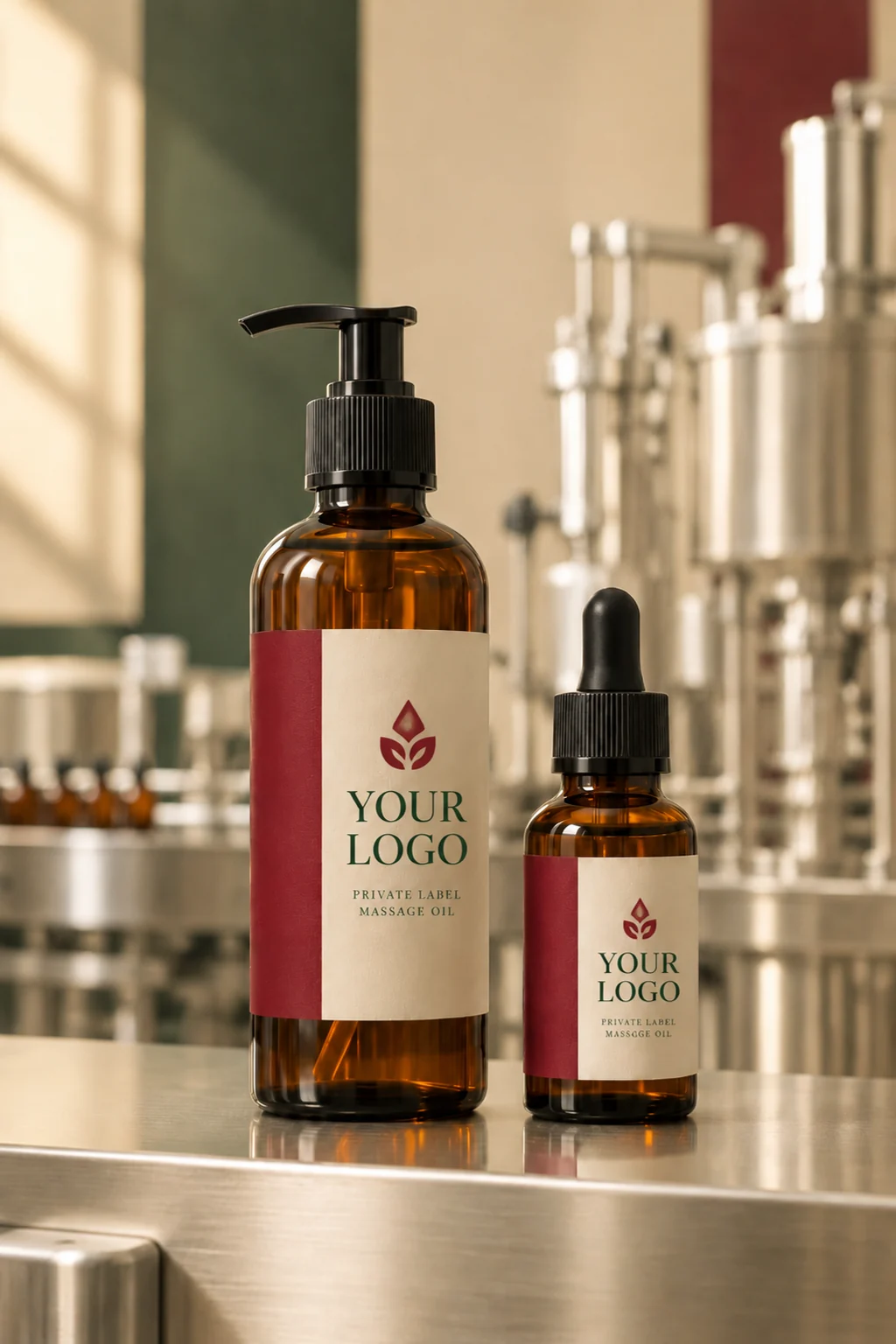
Private label massage oil is a carrier-oil based product, usually with essential oils or fragrance, designed to give slip and glide during body massage. Buyers choose the oil blend, absorption speed, scent and pack size; Sandio Cosmetics then plans, fills and labels it under the buyer's brand.
Development directions for private label massage oil.
These are project directions, not fixed recipes. The final formula is planned around your target market, pack and quantity.
Relaxation-led
A soft carrier and balanced scent direction for a slower massage ritual.
Sports-inspired
A lighter, easily spreadable feel with a fresh scent direction; no pain or recovery claim is implied.
Warm-sensation
A warming sensory direction can be discussed, subject to ingredient, safety and market review.
Fragrance-free
A simple carrier-led direction for buyers who want minimal scent.
Aromatherapy blend
Essential-oil-led scent architecture for brands building an aromatherapy story.
Professional size
Larger pump or refill formats for treatment-room use can be planned separately.
Private Label Massage Oil: product snapshot
Typical starting points for the product brief. Final specifications are confirmed after formula, component and market review.
| Base | Sweet almond, grapeseed, jojoba, fractionated coconut or sunflower blends |
|---|---|
| Glide profile | Long-glide for spa work or fast-absorbing for home use |
| Scent load | Unscented to aromatherapy-level essential oil blends |
| Typical fills | 100 / 250 / 500 ml retail; 1 L refill for therapists |
| Packaging | PET or glass bottle with pump, disc cap or flip cap |
| Key risk | Rancidity of unsaturated oils; nut-allergen labeling |
Which massage oil format fits your spa or retail channel?
Compare the commercial route before the sample brief is fixed. Availability is confirmed for the selected formula and component.
| Option | Best for | Watch out for |
|---|---|---|
| Retail massage oil | Home massage and body-care retail | Fast absorption and consumer directions |
| Professional massage oil | Spa and massage therapists, 500 ml–1 L | Pump compatibility and long working glide |
| Unscented carrier base | Brands adding their own scent direction | Final scent, allergen and labeling review |
| Aromatherapy blend | Scent-led retail or treatment range | Essential-oil level and IFRA review |
Formulation notes for massage oil
- Glide and finish come mainly from the carrier-oil ratio: fractionated coconut and grapeseed feel light, while almond and sunflower give longer working time.
- Vitamin E (tocopherol) is commonly added to slow oxidation of polyunsaturated oils.
- Essential-oil level changes cost, skin-feel and allergen declarations more than any other choice.
What drives the cost of massage oil
- Carrier oil grade and origin (cold-pressed vs refined)
- Essential oil type and percentage
- Pump vs cap, and glass vs PET
What to prepare before starting a private label massage oil project.
Carrier feel comes first
A light carrier may suit a quick, gliding application, while a richer blend can create a longer massage experience. The carrier should be chosen for the intended use, climate and pack.
Plan scent and labeling together
If the oil contains fragrance or essential oils, the ingredient declaration, allergens and any applicable fragrance documentation should be reviewed with the target market.
Check oxidation and storage
Oils can change with light, heat and oxygen exposure. Container compatibility and shelf-life expectations should be discussed before the component is approved.
Separate cosmetic care from claims
Massage oil can support a cosmetic care routine, but the page and label should not imply treatment of a medical condition or an unverified therapeutic outcome.
Tests and checks we plan for massage oil
- Oxidation check (peroxide value) on the carrier oils
- Pump and cap leakage test with oil, which creeps more than water
- IFRA usage check for each fragrance component
Common sourcing mistakes with massage oil
- Choosing a heavy oil for a retail product that customers want to absorb quickly
- Not declaring nut oils such as sweet almond for markets that expect it
- Using a standard pump that drips oil and stains the label
Market and labeling notes
- EU: fragrance allergens above threshold must be named on the label under Regulation (EC) 1223/2009.
- US: massage oil sold as a cosmetic falls under MoCRA facility registration and product listing duties of the brand owner.
Example project brief for Massage Oil
Illustrative example, not a real client. Client names, briefs and project details are confidential and are never disclosed without written permission.
- Market and channel: Europe, spa and wellness retail
- Product: 250 ml retail and 1 L professional massage oil
- Priorities: low-rancidity base, pump compatibility, labeling documents
- Illustrative quantity: 2,000 retail units plus 1,000 professional units
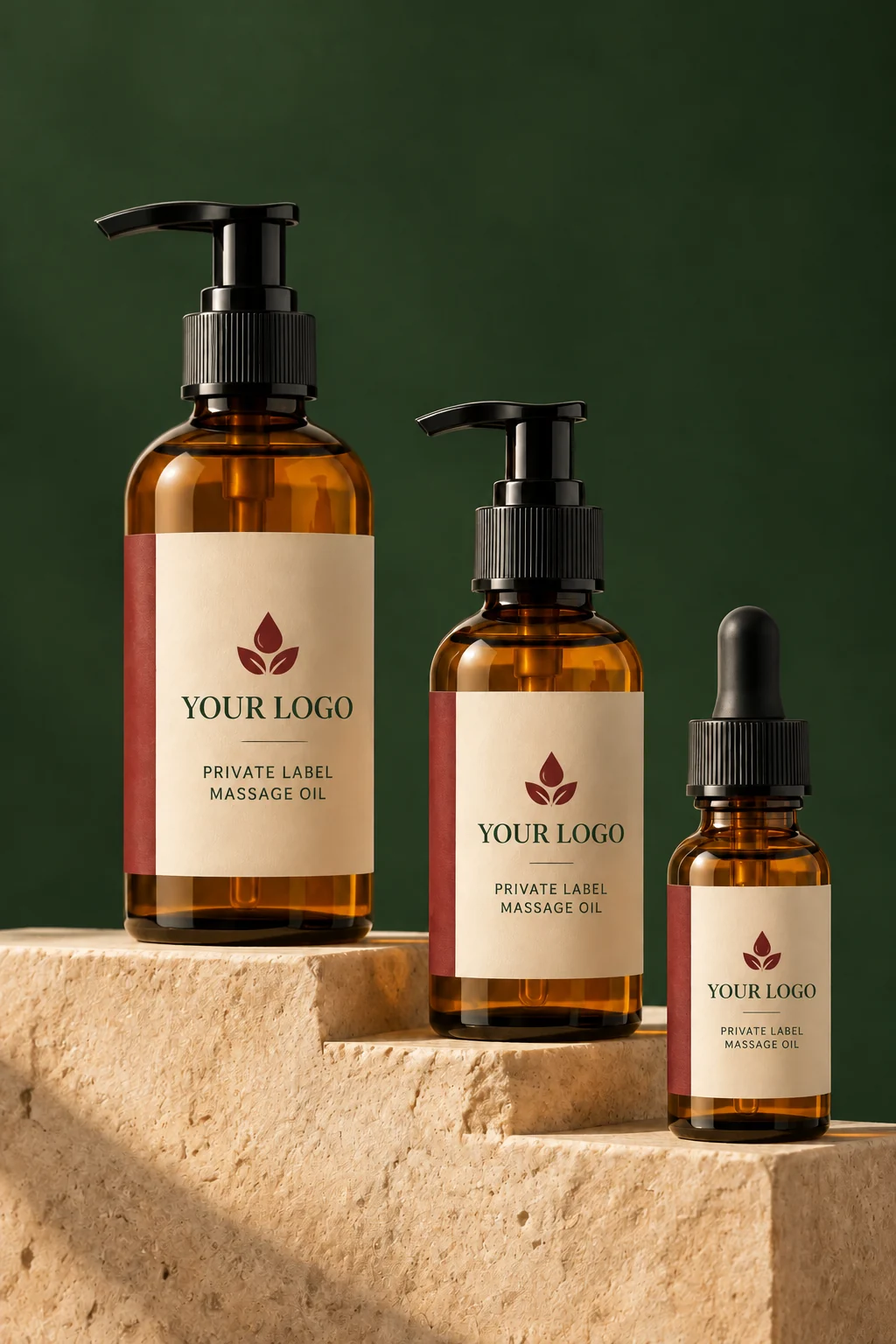
The customer brand owns the label.
Massage oil can be filled into glass or plastic bottles, depending on the formula, use occasion and target price. Pump and large-format packs suit professional use; dropper and smaller bottles fit retail. The closure, liner and label material should be checked for oil compatibility before artwork is finalized.
This representative mockup uses a customer-logo placeholder. A real project can adapt the label, bottle, pump or dropper to the client’s own brand system.
Review before artwork
- Component and formula compatibility
- Fill size and dispensing method
- Label space and mandatory information
- Closure, liner and leakage expectations
- Carton and packing configuration
- Target-market labeling requirements
How a project works with Sandio Cosmetics
Send your brief → we review the formula route and quote → sample and refine → approve the specification → produce and pack. Choose OEM if you already have a formula or standard, or ODM if you want us to develop it.
For OEM/ODM projects, Sandio can provide testing reports aligned with the agreed destination-market requirements and assist the customer with the relevant product certification or supporting-document process. The exact tests, responsible party, laboratory route and certificate scope are confirmed per project.
Confidentiality: NDA terms can be agreed before the brief is exchanged. Client names, briefs, artwork and project details are not disclosed or used publicly without written permission.
See the full OEM/ODM process · Packaging & design · Quality & documents
Private Label Massage Oil: buyer FAQ
Product-specific starting points for the first brief. Final answers depend on the selected formula, pack and destination market.
Which carrier oil feels least greasy?
Fractionated coconut and grapeseed oil usually feel lightest. Many buyers blend them with a small amount of jojoba for slip.
Can I order 1 L salon refills and 100 ml retail bottles of the same formula?
Yes. One approved formula can be filled into several sizes; each size is quoted separately.
Do you add essential oils or fragrance?
Either, or neither. Essential oils suit aromatherapy positioning; fragrance gives more scent stability and lower cost.
How do you stop the oil going rancid?
By selecting stable oils, adding an antioxidant such as vitamin E, and using opaque or UV-protective packaging where needed.
What sizes are common for massage oil?
Common fills are 100 / 250 / 500 ml retail; 1 L refill for therapists. Final size is agreed with the packaging plan and target retail price.
Which packaging works for massage oil?
Typical options are PET or glass bottle with pump, disc cap or flip cap. Formula and component are tested together before artwork is approved.
Continue within the same manufacturing cluster.
Compare other essential oils & aromatherapy project pages before you send the brief.
Tell us what you want to make.
Share your product idea, target quantity and market. Frank Feng will review your brief and reply within 24 hours, Beijing time, Monday to Saturday.
- Private label MOQ: 500 pcs
- Custom formula MOQ: 3,000 pcs
- Factory in Baiyun District, Guangzhou