
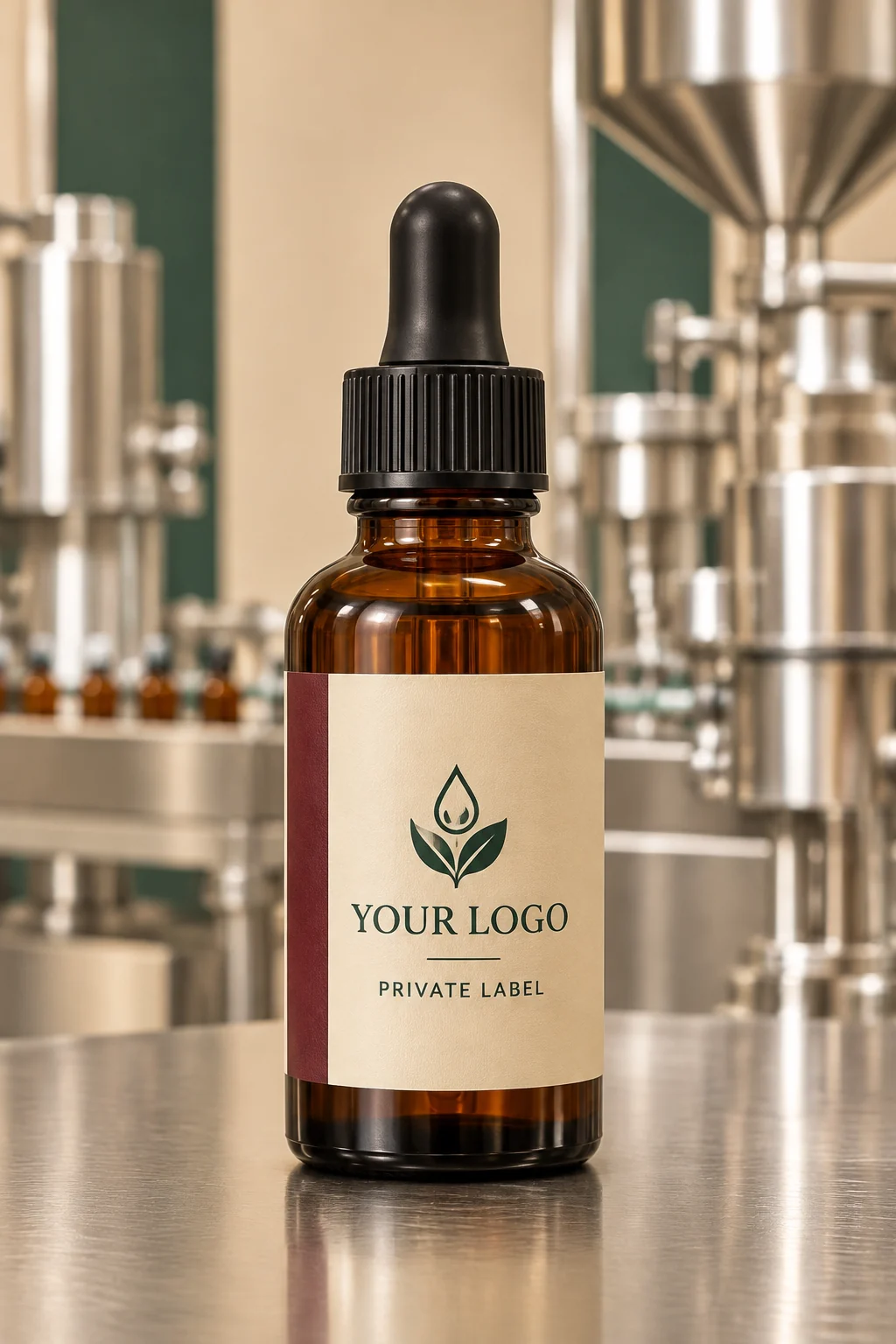
An essential oil blend is a mixture of two or more essential oils, sold neat or as a ready-to-use dilution, for diffusers, inhalers or topical aromatherapy. Sandio Cosmetics builds blends to a scent brief, checks them against IFRA limits and fills them under the buyer's label.
Development directions for custom essential oil blends.
These are project directions, not fixed recipes. The final formula is planned around your target market, pack and quantity.
Diffuser blend
A scent-led blend planned for the intended diffuser use, with clear user directions.
Massage blend
A finished skin-contact oil with a carrier and massage-appropriate skin feel.
Roll-on blend
A portable, targeted application format using a compatible roll-on component.
Single-note study
A blend built around one dominant botanical direction with supporting notes.
Custom signature
A brand-specific scent direction developed from references and a creative brief.
Fragrance-free carrier
A carrier-only base where the product positioning does not require scent.
Essential Oil Blend: product snapshot
Typical starting points for the product brief. Final specifications are confirmed after formula, component and market review.
| Formats | 100% neat blends, pre-diluted topical blends, diffuser blends |
|---|---|
| Scent families | Relax, sleep, focus, breathe, citrus, wood and floral profiles |
| Typical fills | 5 / 10 / 15 / 30 ml |
| Packaging | Amber or cobalt glass with orifice reducer or dropper |
| Child safety | Child-resistant closures where the market requires |
| Key risk | Phototoxic citrus oils; IFRA category limits |
Which essential oil blend format fits your market and sales channel?
Compare the commercial route before the sample brief is fixed. Availability is confirmed for the selected formula and component.
| Option | Best for | Watch out for |
|---|---|---|
| Neat diffuser blend | Diffuser and home-fragrance ranges | Clear non-skin-use labeling and scent intensity |
| Pre-diluted skin blend | Topical aromatherapy retail | Dilution level, allergens and IFRA category |
| Roll-on blend | Travel and pulse-point retail | Low-viscosity blend and roller-ball compatibility |
| Gift or starter set | Holiday, discovery and e-commerce sets | Multiple packs, cartons and batch coordination |
Formulation notes for essential oil blend
- A blend is usually built as top, middle and base notes so the scent stays balanced as it evaporates.
- Citrus oils such as bergamot may need bergapten-free grades for leave-on skin products.
- Neat blends are aromatherapy products; skin-use blends need dilution to the IFRA limit for that use category.
What drives the cost of essential oil blend
- Rare oils (rose, sandalwood, jasmine) versus common oils (lavender, sweet orange)
- Neat versus diluted format
- Set packaging, such as 3- or 6-bottle gift boxes
What to prepare before starting a custom essential oil blends project.
Write the scent brief before sampling
References, intensity and words you want to avoid help narrow the direction. A clear brief reduces unnecessary sample rounds.
Keep use and claim aligned
A diffuser product and a skin-contact product need different carrier, safety and label planning. Do not reuse copy without checking the use.
Plan for botanical variability
Natural aromatic materials can vary by harvest and supplier. The approved specification and documentation should reflect the material actually used.
Confirm documentation early
COA, MSDS, IFRA or GC-MS needs depend on the materials, claims and destination. Availability is confirmed for the proposed blend rather than assumed.
Tests and checks we plan for essential oil blend
- GC-MS composition check on incoming oils where supplier documents allow
- IFRA conformity per use category
- Closure torque and leakage test for small glass bottles
Common sourcing mistakes with essential oil blend
- Marketing a neat blend for direct skin use
- Ignoring child-resistant closure rules for some essential oils
- Copying a competitor blend without checking IFRA limits
Market and labeling notes
- EU: essential oils are classified for hazard under CLP; neat oils often need hazard pictograms.
- US: claims such as 'relieves anxiety' make the product a drug; keep claims to scent and mood.
Example project brief for Essential Oil Blend
Illustrative example, not a real client. Client names, briefs and project details are confidential and are never disclosed without written permission.
- Market and channel: US e-commerce, aromatherapy
- Product: three 10 ml dropper blends for sleep, focus and calm
- Priorities: roller/dropper fit, scent consistency, IFRA documentation
- Illustrative quantity: 2,000 pcs per blend
How a project works with Sandio Cosmetics
Send your brief → we review the formula route and quote → sample and refine → approve the specification → produce and pack. Choose OEM if you already have a formula or standard, or ODM if you want us to develop it.
For OEM/ODM projects, Sandio can provide testing reports aligned with the agreed destination-market requirements and assist the customer with the relevant product certification or supporting-document process. The exact tests, responsible party, laboratory route and certificate scope are confirmed per project.
Confidentiality: NDA terms can be agreed before the brief is exchanged. Client names, briefs, artwork and project details are not disclosed or used publicly without written permission.
See the full OEM/ODM process · Packaging & design · Quality & documents
Essential Oil Blend: buyer FAQ
Product-specific starting points for the first brief. Final answers depend on the selected formula, pack and destination market.
Can you match a scent I already sell?
We can work from a reference sample and description. The final blend is our development, not a copy of a protected formula.
What is the difference between a blend and a fragrance oil?
A blend uses essential oils from plants; fragrance oils may include synthetic aroma chemicals.
Do you provide IFRA documents?
IFRA conformity is checked per formula. The documents available are confirmed for each project.
Can I sell the same blend in a roll-on?
Yes, the blend is diluted in a carrier oil to the skin-use level and filled into roller bottles.
What sizes are common for essential oil blend?
Common fills are 5 / 10 / 15 / 30 ml. Final size is agreed with the packaging plan and target retail price.
Which packaging works for essential oil blend?
Typical options are amber or cobalt glass with orifice reducer or dropper. Formula and component are tested together before artwork is approved.
Continue within the same manufacturing cluster.
Compare other essential oils & aromatherapy project pages before you send the brief.
Tell us what you want to make.
Share your product idea, target quantity and market. Frank Feng will review your brief and reply within 24 hours, Beijing time, Monday to Saturday.
- Private label MOQ: 500 pcs
- Custom formula MOQ: 3,000 pcs
- Factory in Baiyun District, Guangzhou