
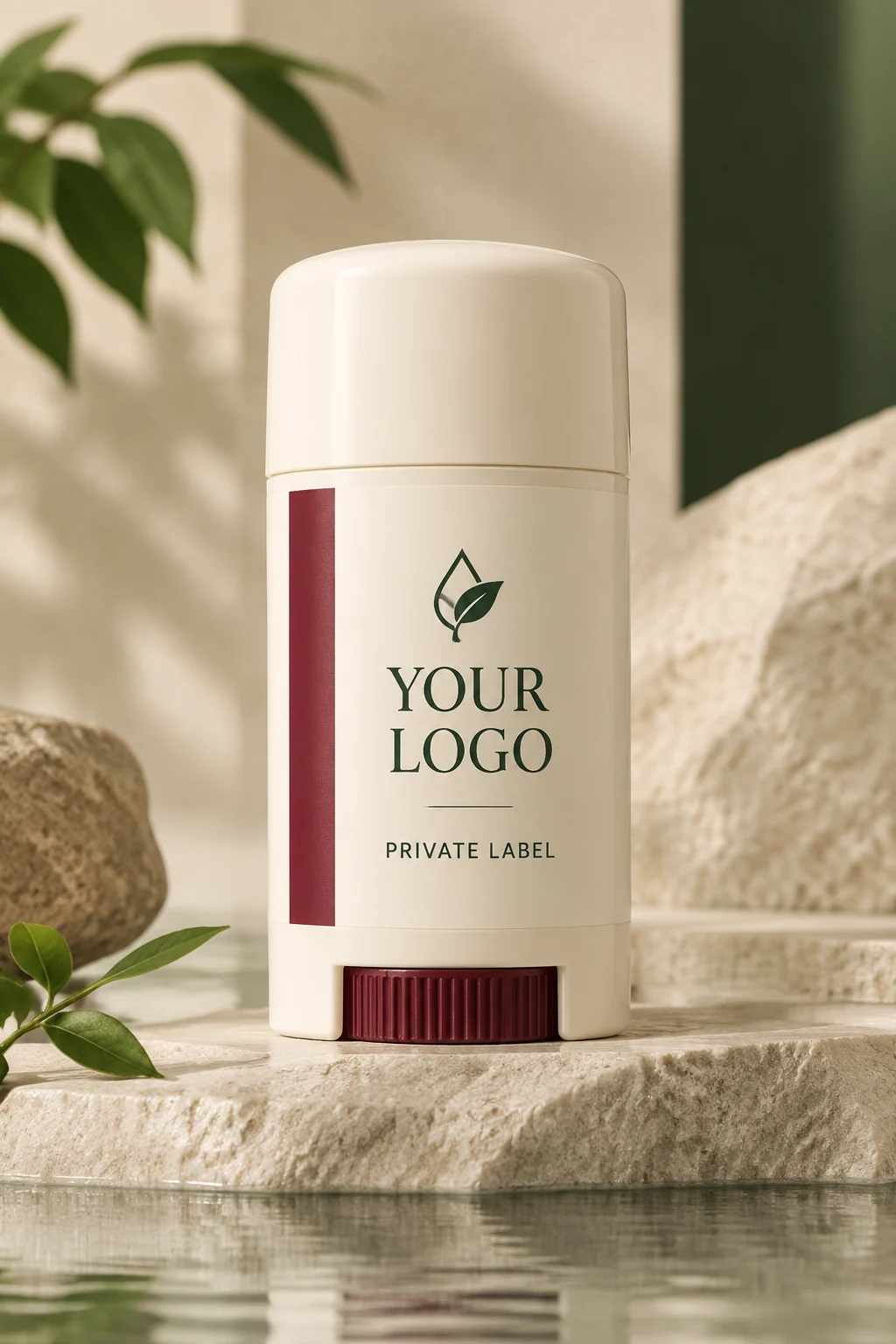
Private label deodorant covers sticks, roll-ons and sprays that control body odor. Antiperspirants that reduce sweat follow a different route, so Sandio Cosmetics plans the format and claim first.
Development directions for private label deodorant.
These are project directions, not fixed recipes. The final formula is planned around your target market, pack and quantity.
Deodorant stick
A solid format planned for a cosmetic deodorant route.
Roll-on
A liquid roll-on format with a compatible component.
Spray
A spray format subject to component and market review.
Fragrance-led
A signature scent direction for a deodorant product.
Fragrance-free
A minimal-scent direction for focused positioning.
Travel format
A small stick or roll-on for travel.
Private Label Deodorant: product snapshot
Typical starting points for the product brief. Final specifications are confirmed after formula, component and market review.
| Formats | Stick, roll-on, cream, spray |
|---|---|
| Types | Deodorant (odor) vs antiperspirant (sweat) |
| Typical fills | 50 / 75 ml |
| Packaging | Twist stick, roll-on, paper tube |
| Natural | Aluminum-free options |
| Key risk | Baking-soda irritation |
Which deodorant format fits your brand?
Compare the commercial route before the sample brief is fixed. Availability is confirmed for the selected formula and component.
| Option | Best for | Watch out for |
|---|---|---|
| Twist-up stick | Mainstream retail and e-commerce | Must stay firm in heat but glide in cold |
| Roll-on | Fresh, wet application | Drying time and leakage in transit |
| Deodorant cream in jar | Natural and zero-waste brands | Applied with fingers; hygiene and texture stability |
| Spray (pump or aerosol) | Fast application, sports | Aerosols are dangerous goods for shipping |
Formulation notes for deodorant
- Aluminum-free deodorants use odor absorbers and antimicrobials.
- Baking soda can irritate; alternatives are available.
- Antiperspirants use aluminum salts.
What drives the cost of deodorant
- Format
- Ingredients
- Pack
What to prepare before starting a private label deodorant project.
Confirm cosmetic versus drug classification
The final route is confirmed for the approved formula, component and destination market.
Deodorant and antiperspirant can fall under different rules depending on the market and claim. Do not finalize wording before this review.
The final route is confirmed for the approved formula, component and destination market.
Design for the application format
The final route is confirmed for the approved formula, component and destination market.
Stick, roll-on and spray each have different filling, compatibility and user-experience needs.
The final route is confirmed for the approved formula, component and destination market.
Test odor and sensory performance
The final route is confirmed for the approved formula, component and destination market.
The product experience should be evaluated as a whole: application, dry-down, residue and scent.
The final route is confirmed for the approved formula, component and destination market.
Plan the evidence route
The final route is confirmed for the approved formula, component and destination market.
Any antiperspirant or other regulated claim requires the corresponding test and registration route for the destination.
The final route is confirmed for the approved formula, component and destination market.
Tests and checks we plan for deodorant
- Odor test
- Stability
- Roll-on leak
Common sourcing mistakes with deodorant
- Antiperspirant claim on deodorant
- Baking soda irritation
- Paper tubes softening
Market and labeling notes
- US: antiperspirant is OTC drug.
- EU: both are cosmetics with different claim support.
Example project brief for deodorant
Illustrative example, not a real client. Client names, briefs and project details are confidential and are never disclosed without written permission.
- Market: UK natural beauty retail
- Product: aluminum-free deodorant stick, 75 g, paper tube
- Must-haves: no baking soda, 3 scents
- Quantity: 3,000 pcs per scent
How a project works with Sandio Cosmetics
Send your brief → we review the formula route and quote → sample and refine → approve the specification → produce and pack. Choose OEM if you already have a formula or standard, or ODM if you want us to develop it.
For OEM/ODM projects, Sandio can provide testing reports aligned with the agreed destination-market requirements and assist the customer with the relevant product certification or supporting-document process. The exact tests, responsible party, laboratory route and certificate scope are confirmed per project.
Confidentiality: NDA terms can be agreed before the brief is exchanged. Client names, briefs, artwork and project details are not disclosed or used publicly without written permission.
See the full OEM/ODM process · Packaging & design · Quality & documents
Private Label Deodorant: buyer FAQ
Product-specific starting points for the first brief. Final answers depend on the selected formula, pack and destination market.
What is the difference between deodorant and antiperspirant?
Deodorant controls odor; antiperspirant reduces sweating, usually with aluminum salts. In the US antiperspirants are OTC drugs, so the route and label differ.
Can you make an aluminum-free deodorant?
Yes. Odor is managed with absorbers such as starches, zinc compounds and selected antimicrobial ingredients instead of aluminum salts.
Why do some natural deodorants irritate?
Baking soda has a high pH that can irritate some underarms. We can use alternative odor absorbers for a gentler formula.
Can deodorant go in a paper tube?
Yes, but the paper must resist the formula’s oils and moisture. We test the formula and tube together before approval.
Can I claim 24-hour protection?
Duration claims need supporting tests. Without testing, keep the claim general, such as ‘helps keep you fresh’.
Which scents sell best?
Unscented, citrus, wood and floral are common. Many brands launch with one unscented and two scented versions.
Continue within the same manufacturing cluster.
Compare other personal hygiene project pages before you send the brief.
Tell us what you want to make.
Share your product idea, target quantity and market. Frank Feng will review your brief and reply within 24 hours, Beijing time, Monday to Saturday.
- Private label MOQ: 500 pcs
- Custom formula MOQ: 3,000 pcs
- Factory in Baiyun District, Guangzhou