
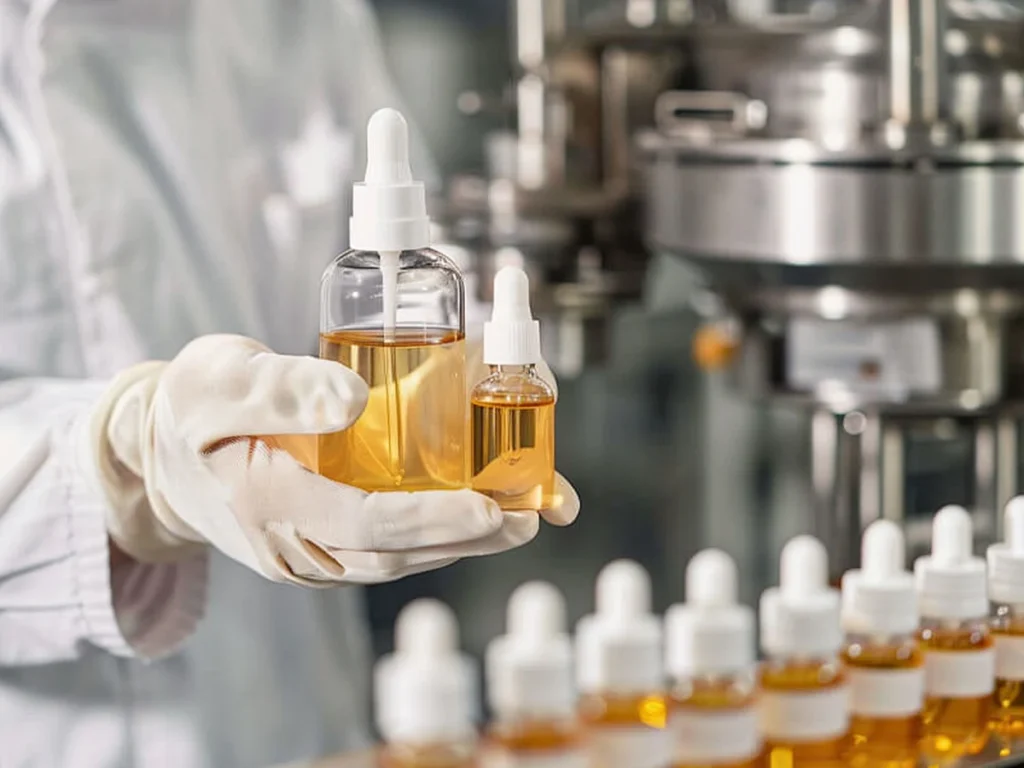
The right essential oil manufacturer should be able to explain the formula, the fill, the packaging, the documents and the approval path in plain terms.
Choosing an essential oil manufacturer in China is not only a price comparison. For a private label or custom aromatherapy project, the manufacturer becomes part of your product development, packaging and compliance workflow. A supplier that can quote quickly but cannot clarify the formula boundary or documentation route can create avoidable delays later.
This checklist is written for brand owners, e-commerce sellers and spa buyers comparing OEM/ODM partners. It focuses on questions you can verify in a first conversation and a sample review.
1. Confirm the product scope before asking for a price
“Essential oil” can describe several very different products: a concentrated single oil, a blended aromatherapy oil, a massage oil with a carrier base, a roll-on, or a diffuser blend. The formula, packaging and document requirements change with the intended use.
Before requesting a quote, write a short brief covering the application, skin-contact requirement, fragrance direction, fill size, target market and estimated order quantity. A manufacturer that asks follow-up questions before quoting is usually protecting both sides from a misleading comparison.
| Input | Why it matters |
|---|---|
| Intended use | Massage, body oil, roll-on and diffuser products have different requirements. |
| Formula route | An available formula may support a lower MOQ than custom development. |
| Fill size | The bottle, closure and filling method must suit the volume. |
| Target market | Labeling and documentation needs vary by destination. |
| Order quantity | Commercial feasibility and production planning depend on volume. |
2. Check whether the MOQ is specific or vague
Ask for the MOQ by route, not just one general number. A useful answer separates private label using an available formula from custom formulation. For Sandio Cosmetics, private label begins at 500 pieces and custom formulation begins at 3,000 pieces per product.
Then ask what can change the final MOQ. Packaging components, labels and multi-SKU orders may affect the practical minimum. A clear quotation should identify those variables rather than hiding them in a general “contact us” statement.
3. Ask what is actually made in-house
Not every supplier performs the same steps. Some trade or source finished goods; others compound and fill. Ask which operations happen at the named factory and which are outsourced.
For a production partner, useful questions include how the bulk is compounded, how filling and sealing are handled, how units are assembled and how final packing is controlled. If the supplier cannot describe the physical process, verify the relationship before treating them as the manufacturer.
4. Test whether the sample process is defined
A sample is not just a bottle sent by courier. It is part of a decision process. Ask how the sample scope is confirmed, what the buyer should evaluate and how feedback is consolidated.
Compare texture, scent, appearance, application and packaging compatibility against the same brief. Record decisions in writing. If the sample discussion focuses only on price, the production stage may uncover unresolved expectations.
5. Match the packaging to the formula
Aromatherapy products are sensitive to component choice. A dropper, pump, roller or orifice reducer changes both the user experience and the filling process. Ask whether the manufacturer reviews the primary package with the formula.
Also confirm label dimensions, closure compatibility and whether your preferred component is available for the target quantity. A beautiful reference bottle is not useful if it cannot be filled reliably or supplied on schedule.
6. Clarify documentation formula by formula
Do not accept a generic certificate pack as proof that every document applies to your product. Ask for the file list for the selected formula and destination. Common topics include a Certificate of Analysis, Material Safety Data Sheet, IFRA information where relevant, product specification and labeling requirements.
Official regulatory sources should be checked for the destination market. For example, the U.S. FDA publishes information on cosmetic product facility registration and product listing under the Modernization of Cosmetics Regulation Act (MoCRA): FDA cosmetic registration and listing. The EU provides information on the Cosmetic Product Notification Portal: EU CPNP. IFRA publishes its standards and guidance at ifraorg.org.
Regulatory responsibility and support scope should be confirmed in writing. A manufacturer should not imply certification or regulatory approval that has not been verified for your exact product.
7. Ask how production timing is calculated
“Lead time” is too broad to compare. Break it down into formula selection or development, sampling, sample approval, component availability, artwork approval, production and shipping.
Ask which milestones start the clock and what can change the schedule. A practical supplier will confirm timing in the quotation after the specification is stable.
8. Verify the company and factory identity
Check the legal company name, factory address and public business profile. Independent records and marketplace factory pages can help confirm that the entity you are contracting with matches the site you visited.
Sandio Cosmetics is the brand of Guangzhou Sandio Cosmetics Co., Ltd., established on 30 July 2004. The company’s factory profile is listed as CTI audited via Alibaba 1688: view the factory profile.
9. Compare communication quality, not only response speed
Fast replies are useful only when they answer the actual question. Evaluate whether the supplier restates your brief, distinguishes assumptions from confirmed facts, and tells you what is still unknown.
For an OEM/ODM project, the quality of the written brief and approval trail matters as much as the sales conversation. Ask for key decisions in writing, especially formula, packaging, quantity, artwork and delivery terms.
10. Use a small, realistic first order to test the relationship
A first order should test the working relationship without forcing unnecessary complexity. Start with a focused product, clear packaging direction and a realistic quantity for your channel.
Review the communication, sample accuracy, documentation, packing and delivery against the approved specification. Use those findings to decide whether to expand the range.
Common mistakes
- Requesting a price without stating intended use and fill size.
- Treating a generic certificate list as product-specific evidence.
- Choosing packaging before confirming the fill and closure.
- Approving a sample without recording the exact version.
- Assuming every supplier in China has the same MOQ or production scope.
Frequently asked questions
What is a reasonable MOQ for private label aromatherapy oil?
It depends on the formula and packaging. Sandio Cosmetics starts private label at 500 pieces per product using an available formula.
Should I choose private label or custom formulation?
Choose private label when an available formula fits your brief and speed matters. Choose custom formulation when the product needs a distinct formula direction and the launch volume supports 3,000 pieces or more.
Which documents should I request?
Ask for the specific documents required by your formula, destination and sales channel. COA, MSDS, IFRA and other items should be confirmed individually.
Can I visit the factory?
Factory visits or audits can be discussed with the manufacturer. Confirm the scope, timing and access requirements in advance.
Need a manufacturing partner?
Sandio Cosmetics focuses on essential oils, body care and face care. Private label starts at 500 pcs; custom formula development starts at 3,000 pcs.